

1 Introduction
Fermionic Gaussian states are a very useful tool in condensed matter and many-body physics [1, 2]. Besides faithfully representing the eigenstates of non-interacting fermionic Hamiltonians [3], their simplified mathematical structure makes them ideal toy models that are routinely employed in different areas of physics. For instance, in the context of quantum computation, fermionic Gaussian states naturally appear using the Jordan-Wigner (JW) transformation [4], mapping spin (or qubit) degrees of freedom to fermionic ones. The circuits made of gates that can be mapped to free-fermion dynamics in this way are known as matchgate quantum circuits [5]. They play an important role, since the mapping to free fermions makes it possible to simulate them efficiently on a classical computer [6, 7]. More generally, fermionic Gaussian states are becoming increasingly relevant in the development of new quantum technologies. For example, several algorithms now allow us to efficiently learn an experimentally prepared fermionic Gaussian state [8–12], offering non-trivial benchmarking opportunities.
Given a many-body fermionic state (or a qubit state which can be mapped to fermions via a JW transformation), it is interesting to ask how much it differs from a Gaussian state. For example, in the context of many-body physics, quantifying the non-Gaussianity of a state gives us a measure of the interactions of its parent Hamiltonian [13–16]. In quantum computation theory, instead, fermionic non-Gaussianity can be seen as a resource enabling universal quantum computation in matchgate circuits [7, 17]. A natural framework to quantify the deviations of a state from being Gaussian is that of quantum resource theories (QRT) [18], originally introduced in the context of quantum information theory.
In a QRT, one indirectly defines a quantity of interest (the resource) in terms of free states and operations, which do not display or generate the resource, respectively. The resource of interest (in our case, the fermionic non-Gaussianity) is then quantified by suitable monotones, namely real functions over the Hilbert space that are vanishing on the set of free states and do not increase under free operations [18]. In the QRT of fermionic non-Gaussianity, free states and operations are the Gaussian ones [1, 19–27].
In this work, we focus on the relative entropy of fermionic non-Gaussianity [28–32], a popular monotone in the non-Gaussianity QRT, and relate it to the number entropy of the symmetrized state [33–37]. That is, the classical Shannon entropy of the probability distribution of the particle number, which for pure states coincides with the particle-number asymmetry [38]. Specifically, we derive a lower bound on the relative entropy of non-Gaussianity in terms of the exponential of the Shannon entropy, and study numerically its tightness for large system sizes. Our bound is non-trivial for large values of the asymmetry and relies on the concentration of the particle-number distribution of (mixed) fermionic Gaussian states.
The implications of our work are two-fold. On the one hand, when the particle-number is experimentally accessible, the particle-number Shannon entropy can be estimated efficiently [39], so that our results can be used as a practical way to lower bound non-Gaussianity. In this respect, it is worth mentioning that the total particle number can be measured efficiently also in quantum-circuit setups [40–43], making our results relevant even for digital quantum platforms. On the other hand, our work provides a link between two different QRTs. Indeed, the notion of asymmetry can also be formalized via a QRT [18, 44–46] (see also refs. [47–53] for similar ideas developed in the context of many-body physics and quantum field theory). Our results can then be put in the framework introduced in ref. [54], which studied how the free states of one QRT can be resourceful when analyzed through the lenses of a second one. More generally, our findings highlight a non-trivial interplay between non-Gaussianity and particle-number asymmetry.
The rest of this work is organized as follows. We begin in section 2, where we briefly recall the notions of Gaussian states, non-Gaussianity, and asymmetry. In section 3, we start characterizing Gaussian states in terms of the distribution of the number of particles: after presenting an elementary bound on the particle-number Shannon entropy for Gaussian states in section 3.1, we give a bound of non-Gaussianity in terms of the minimal trace distance from the set of Gaussian states (also known as interaction distance [13, 14]). Our main results are presented in section 4. In particular, after some preliminary considerations in section 4.1, in section 4.2 we provide a lower bound on the relative entropy of non-Gaussianity for a special family of states, while a completely general bound is derived in section 4.3. Finally, section 5 contains our conclusions, while a few appendices present the most technical parts of our work.
2 Preliminaries
We begin by recalling some preliminary facts about fermionic Gaussian states, the particle-number Shannon entropy, and the QRT of non-Gaussianity and asymmetry.
2.1 Fermionic Gaussian states
We consider a system of fermionic modes, satisfying canonical anti-commutation relations
for . We will denote by the corresponding Hilbert space. A mixed, full-rank state on is a fermionic Gaussian state if it can be represented as
| (2.2) |
where is a quadratic operator of the form
| (2.3) |
while is a normalization constant. Introducing the compact notation
| (2.4) |
the operator can be rewritten as
| (2.5) |
with
| (2.6) |
More generally, a state (not necessarily mixed) is called Gaussian if it can be obtained from the expression (2.2) by taking the limit to infinity of some of the coefficients and in eq. (2.3). For instance, a pure Gaussian state can be obtained from a thermal state of the form (2.2), by taking the limit where the inverse of the temperature is taken to infinty.
We recall that fermionic Gaussian states satisfy Wick’s theorem [1]. As a result, they are completely characterized by the corresponding two-point correlation functions, which we can collect in the correlation matrix
| (2.7) |
with
| (2.8) |
In particular, the correlation matrix associated with a Gaussian state gives us access to its von Neumann entropy
| (2.9) |
Indeed, one can show that the eigenvalues of are real and come in pairs of the form , and that the von Neumann entropy is given by [55, 56]
| (2.10) |
2.2 Non-Gaussianity, particle number Shannon entropy, and asymmetry
In this section, we introduce the relative entropy of non-Gaussianity, the particle-number Shannon entropy, and the -asymmetry. The relative entropy of non-Gaussianity and the -asymmetry are two monotones for the QRTs of non-Gaussianity and asymmetry, respectively, both defined in terms of a relative von Neumann entropy. As stated in the introduction, a faithful resource monotone is a real function over the Hilbert space such that for every resource-free state , and for every quantum channel implementing a free operation [18].
The non-Gaussianity of a state can be characterized through different monotones. A natural choice is the trace distance, ,
| (2.11) |
where denotes the set of all Gaussian states. However, this quantity requires us to perform a minimization over all Gaussian states in the Hilbert space, making it highly inefficient to use. Another widely used monotone to quantify the non-Gaussianity of a state is the fermionic antiflatness (FAF) [27, 57] which only requires the computation of the correlation matrix . However, the FAF is limited to pure states. To get around these problems, in this work we consider the relative entropy of non-Gaussianity [28–30], defined as
| (2.12) |
where the minimum is taken over the set of all Gaussian states and
| (2.13) |
with the convention that if . While originally introduced in the context of bosonic Gaussian states [58], it is straightforward to see that the relative entropy of non-Gaussianity is a monotone, and hence a good measure of non-Gaussianity, also with respect to the fermionic QRT. Namely, in ref. [31] it was proven that if and only if the state is Gaussian and for every Gaussian quantum channel , i.e. a completely positive and trace-preserving operation mapping Gaussian states into Gaussian states.
As shown in ref. [30] for bosonic Gaussian states, given a state , the state realizing the minimum in eq. (2.12) is its Gaussianification , namely the Gaussian state with the same correlation matrix (such state always exists). This definition can be readily extended to the fermionic case by replacing the bosonic covariance matrix with the fermionic correlation matrix in eq. (2.7) [26, 31]. Accordingly, using the properties of , one can rewrite [30]
| (2.14) |
Although eq. (2.14) does not feature any minimization procedure, the minimization is implicit in the definition of : the Gaussian state with the same two-point correlation matrix (2.7) as is the closest fermionic Gaussian state to in relative entropy (see ref. [59] for a proof). In fact, for pure states , so that can be computed only from the correlation matrix as
| (2.15) |
where is the set of eigenvalues of . In many cases, can be computed efficiently even in the many-body setting, justifying the appeal of the relative entropy of non-Gaussianity over different monotones. Note that, for a mixed state , the r.h.s of eq. (2.15) only provides an upper bound for .
Next, we discuss the particle-number Shannon entropy. We first introduce the charge
| (2.16) |
which is just the particle-number operator. Given a state , we can then define the charge probability distribution function
| (2.17) |
where , while is the projector over the -eigenspace of the charge . The particle-number Shannon entropy is then
| (2.18) |
For a pure state, the largest the Shannon entropy the more the state breaks the symmetry associated with the charge . In fact, the Shannon entropy is closely related to a natural monotone within the QRT of asymmetry [38, 45, 46, 60, 61], as we now briefly review.
In the asymmetry QRT, one defines free states and operations as those that preserve a certain symmetry group . In our case, this is the symmetry group associated with the charge , . The amount of asymmetry in a state is quantified by the -asymmetry [38] (also known as entanglement asymmetry [48])
| (2.19) |
where we introduced the twirling operator
| (2.20) |
Similarly to the relative entropy of non-Gaussianity, the -asymmetry is a faithful monotone, meaning that (see [62] and references therein) if and only if the state is -symmetric, and for every -symmetric quantum channel .
The connection with the particle-number Shannon entropy introduced above comes from the inequality [62]
| (2.21) |
which is saturated for pure states. Therefore, the particle-number Shannon entropy coincides with the asymmetry for pure states, consistent with physical intuition.
Recently, the asymmetry has received increasing attention beyond the QRT framework. In particular, the observation that it can be efficiently computed in physically interesting settings led to several studies of asymmetry in the context of quantum thermalization [48, 63–69], typical quantum states [70–74], QFT [49–52, 75–81], and generalized symmetries [82–84]. It is also experimentally accessible in several relevant quantum platforms [63, 74, 85].
3 Particle-number distribution of Gaussian states
In this section, we characterize Gaussian states in terms of the distribution of the number of particles. We first present an elementary bound on the particle-number Shannon entropy for Gaussian states. Then, we show that violations of this bound for a state give us a lower bound on the trace distance of from the set of Gaussian states.
3.1 A bound on the particle-number Shannon entropy
It is well known that Gaussianity constrains the particle-number distribution function. In fact, particle-number fluctuations in Gaussian states have been studied in several settings, including generic states [86] and ground states of specific models [87, 88], as well as during quantum quenches [89–91]. Previous work has also already unveiled non-trivial connections between the particle-number distribution and other physical quantities. For instance, when the particle number is conserved, its fluctuations within a subsystem were shown to provide a lower bound on the bipartite entanglement entropy [34, 92, 93]. Here, we review some elementary facts yielding a simple upper bound on the particle-number Shannon entropy of Gaussian states.
Given a Gaussian state, we may write the first and second moment of the charge distribution function in terms of the correlation matrices (2.8). In particular, a simple application of Wick’s theorem yields
| (3.1) |
and
| (3.2) |
Therefore, denoting by the charge variance and using (2.7), we have
| (3.3) |
Since the eigenvalues of both and are real and lie in the interval , it holds and . Applying these inequalities to eq. (3.3), we conclude
| (3.4) |
In turn, using the known bound for the Shannon entropy of a classical discrete distribution function in terms of its variance [94, 95], we get
| (3.5) |
which is the desired bound on the particle-number Shannon entropy for Gaussian states. Note that, while we focused on the distribution of the eigenvalues of the particle-number operator , a similar bound could be derived for any local quadratic charge.
Combining with eq. (2.21), we also obtain a bound on the asymmetry of a Gaussian state ,
| (3.6) |
Note that, for a generic state, the asymmetry can be as large as [46]. Consequently, non-interacting systems cannot maximally break a symmetry associated to a quadratic charge. In other words, maximal asymmetry requires interactions.
3.2 An elementary bound for the trace distance
Eq. (3.6) implies that states with large asymmetry cannot be Gaussian. As an example, one can consider a uniform superposition of charge eigenstates ,
| (3.7) |
The state is maximally asymmetric, since . Thus, regardless of the choice of , the state is not Gaussian. However, its non-Gaussianity depends on the specific choice of , and quantifying it is generally non-trivial. The rest of this work is devoted to putting a lower bound on the non-Gaussianity when the particle-number Shannon entropy (and thus, for pure states, the asymmetry) exceeds the r.h.s. of eq. (3.5).
As is turns out, this task is non-trivial when considering the relative entropy of non-Gaussianity, and will be tackled in the next section. Here, we first present a simpler result, giving a lower bound on the trace distance of a state from the set of Gaussian states. Specifically, denoting as usual the Shannon entropy of by , we show
| (3.8) |
where is a constant (independent of and ). Note that the l.h.s. is known in the literature as interaction distance [13, 14].
In order to prove the above inequality, let us consider an arbitrary Gaussian state , and define the probabilities and . From these, we can construct the mixed states
| (3.9) |
which are defined in a Hilbert space of dimension . Notice that by construction and . Thus, applying the Fannes inequality [96], we get
Next, the mixed states in eq. (3.9) can be written as , , where we introduced the trace preserving channel
| (3.11) |
As a consequence, since the trace distance is non-increasing under CPTP channels [96], we arrive at
| (3.12) |
Combining eqs. (3.10) and (3.12) and taking into account that is upper bounded by eq. (3.5), we find precisely (3.8).
4 A lower bound on fermionic non-Gaussianity
This section contains our main results. After presenting some preliminary considerations in section 4.1, in section 4.2 we provide a lower bound on the relative entropy of non-Gaussianity for a special family of states, while a completely general bound is derived in section 4.3.
4.1 Preliminary considerations
Strictly speaking, eq. (3.8) already provides a lower bound on the relative entropy of non-Gaussianity. To see this, we may use Pinsker’s inequality [97], stating that for any two states and ,
| (4.1) |
Applying it to and in eq. (3.8), we obtain
| (4.2) |
Unfortunately, as we will show, the inequality (4.2) provides a bound which is not tight. Before seeing this explicitly, we find it instructive to analyze the asymmetry and the non-Gaussianity of a special family of states, allowing for analytic computations. Below, we show that for this family the relative entropy of non-Gaussianity is bounded by the exponential of the Shannon entropy and grows linearly in for maximal asymmetry. Conversely, since , the r.h.s. of eq. (4.2) is asymptotically upper-bounded by a constant, suggesting that the bound is indeed not tight. In fact, in section 4.3 we will employ a very different strategy and derive a general lower bound on the non-Gaussianity, which recovers a linear growth in for maximally asymmetric states.
4.2 Superposition of kink states
Consider the one-parameter family of states
| (4.3) |
where is the fermionic vacuum annihilated by all and the coefficients are chosen to be
| (4.4) |
with . Each is a “kink state”, and is obviously a charge eigenstate with eigenvalue . The simple form of the states (4.3) allows us to perform analytic computations. In addition, by varying the parameter , the asymmetry of can be tuned from 0 () to (), allowing us to study the interplay between asymmetry and non-Gaussianity. Quantitatively, by setting with , the asymmetry of reads
| (4.5) |
Note that the state breaks the fermion parity, namely it is not an eigenstate of , but this is irrelevant for our discussion. In fact, one could also study similar families of states featuring, say, only even kink states, arriving at similar conclusions.
In order to bound the non-Gaussianity of the state (4.3), we first rewrite eq. (2.15) as
| (4.6) |
where is the binary entropy in natural units. Using the simple bound [98]
| (4.7) |
and making use of eq. (2.7), we arrive at the inequality
| (4.8) |
which is valid for any pure state .
Next, as we show in appendix A, for the family of states (4.3) we can compute
Finally, recalling that, according to eq. (4.5), for the states (4.3) , we arrive at the result
| (4.10) |
The lower bound (4.10) can be verified numerically for all values of by diagonalizing the correlation matrix to obtain the exact value of . We present results for for all parameters of (and hence the full range of possible values of the asymmetry) in figure 1. Evidently, the lower bound (4.10) follows the actual values very closely and captures the scaling of the non-Gaussianity
| (4.11) |
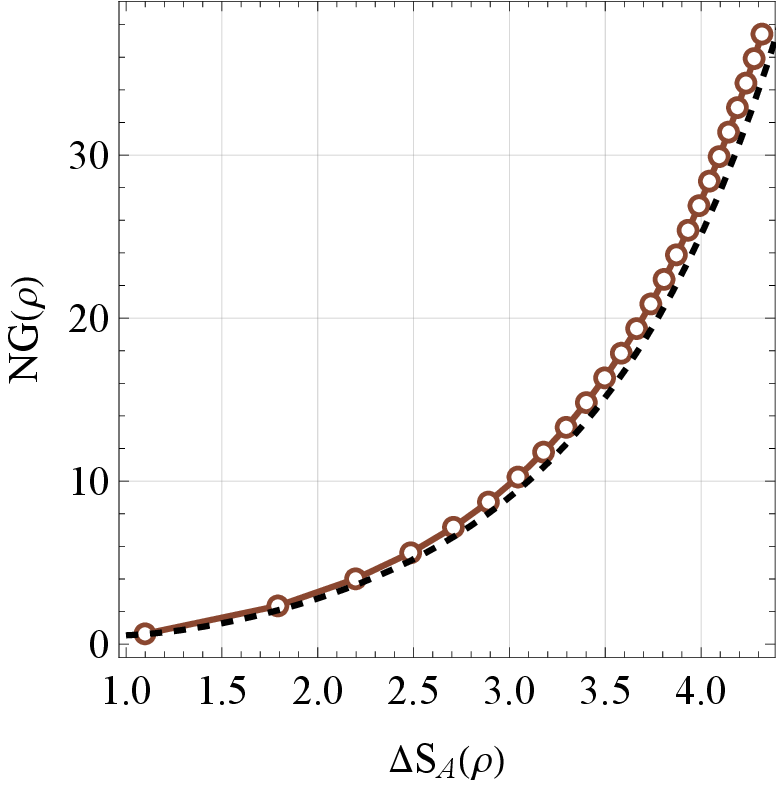
More generally, we have also studied numerically the non-Gaussianity for different families of states with large asymmetry for small values of . In all cases the bound in eq. (4.2) appears to be manifestly non-tight, motivating the derivation of a tighter bound. We do this in section 4.3 using a different approach based on a concentration result for the particle-number distribution of (mixed) fermionic Gaussian states.
4.3 Derivation of the lower-bound
In this section, we provide a general lower bound on the relative entropy of non-Gaussianity, significantly improving eq. (4.2). Our strategy is based on the following concentration inequality. Denoting by a Gaussian state with average charge , one can prove
| (4.12) |
where is the charge variance of the state , while is the probability that the charge takes values outside of the interval . Physically, this result states that the fluctuations of the total charge, , are strongly suppressed away from their mean. Indeed, for Gaussian states with , fluctuations of size are typical, while extensive deviations, , are exponentially suppressed in the system size.
While concentration inequalities such as eq. (4.12) are well established for pure Gaussian states [99, 100], we are not aware of explicit proofs in the case of mixed states. In fact, the extension to mixed states requires a more careful analysis. We prove eq. (4.12) in appendix B, based on an exact representation of the charge cumulant generating function for (mixed) Gaussian states [89, 101].
Next, we can summarize the strategy to derive our bound as follows. If a state has a large Shannon entropy, the particle-number distribution function must be anti-concentrated, and therefore different from the one of Gaussian states. In particular, there must be particle-sectors of the Hilbert space where the support of is large, while that of its Gaussianification is exponentially small. This difference gives rise to the divergence of the relative entropy between and for .
To be precise, let us consider a state and denote by the corresponding particle-number probability distribution function. For ease of notation, we will denote
| (4.13) |
and assume with (otherwise the bound is trivial). Setting , it is intuitive that if is very large, can not be too small. Introducing , which is the number of integer charge sectors satisfying , this follows from the Jensen’s inequality, yielding
| (4.14) |
and therefore
| (4.15) |
This inequality shows that once the entropy exceeds , the tails of the probability distribution function must be strictly positive.
Proceeding with the argument, let be the Gaussianification of . We define two orthogonal projectors
with . These operators project onto central and tail charge sectors, respectively. We also introduce the quantum channel
| (4.18) |
By using the data processing inequality, we get
| (4.19) |
where and similarly for . Since both states are block-diagonal in this decomposition, from the expression of the -resolved relative entropy [102], we obtain the following bound
where, for , we defined , , together with the probabilities , , and , are defined analogously. To obtain the final inequality in eq. (4.20), we used the fact that it always holds . Now, restricting to , eq. (4.15) gives us the explicit bound
| (4.21) |
On the other hand, applying eq. (4.12) to the Gaussian state with threshold , we obtain
| (4.22) |
Finally, by plugging eqs. (4.21) and (4.22) in eq. (4.20), and using eq. (4.19), we arrive at
| (4.23) |
where is defined in eq. (4.21).
Eq. (4.23) is our main result. While it is true for all values of with (so that ), we can choose, for instance, to obtain an explicit bound. In this case, the leading scaling behavior of the r.h.s. side can be extracted using that , yielding
which displays the previously announced improved scaling over eq. (4.2). For instance, for maximal entropy , it yields , where is a constant, . This scaling recovers the linear growth of the relative-entropy of non-Gaussianity (4.10) derived for the family of kink states (4.3).
For smaller entropy with , an additional logarithmic correction appears. In this case, we have not been able to find examples saturating the bound. In fact, for generic states analytic computations are not possible and we are restricted to numerical computations for relatively small system sizes. This makes it difficult to understand whether the scaling predicted by eq. (4.24) is tight. We leave this question for future work.
5 Outlook and discussions
In this work, we have investigated the interplay between two different quantum resources in the many-body setting: non-Gaussianity and asymmetry. In particular, we have derived a general bound on the relative entropy of non-Gaussianity in terms of the Shannon entropy of the particle-number distribution, which coincides with the particle-number asymmetry for pure states. The relevance of our work is two-fold. On the one hand, our results can be viewed as a practical way to lower bound non-Gaussianity. On the other hand, we provide a link between two different QRT in the context of fermionic systems, in the spirit of ref. [54].
Our work raises some questions for future research. First, it would be important to understand whether our bound is tight or, conversely, how to improve it. In the case of maximally asymmetric states, we have shown that the scaling of the bound is optimal, but the question remains open for lower asymmetry.
Second, a natural question pertains to the extension of our results to bosonic systems. In this case, it is easy to see that a bound of the non-Gaussianity in terms of the Shannon entropy as the one we have derived cannot hold. This is because the particle-number Shannon entropy for bosonic Gaussian states is unbounded, as it can be seen for a single bosonic mode. However, one may wonder whether a bound on non-Gaussianity can be obtained by studying refined properties of the particle-number distribution. This would be particularly interesting, given the prominent role that bosonic Gaussian states play in the context of quantum optics [58]. We leave these questions for future research.
Acknowledgments
LP acknowledges fruitful discussions with Ludovico Lami, especially regarding possible extensions to the bosonic case. This work was funded by the European Union (ERC, QUANTHEM, 101114881 and ERC, MOSE, 101199196). Views and opinions expressed are however those of the author(s) only and do not necessarily reflect those of the European Union or the European Research Council Executive Agency. Neither the European Union nor the granting authority can be held responsible for them.
Appendix
A Correlation matrices and lower bound for the superposition of kink states
Here we provide some additional details about the computation of the lower bound for the non-Gaussianity of the family of states considered in section 4.2, namely
| (A.1) |
where the coefficients are:
| (A.2) |
with .
Our starting point is the inequality (4.8). For the state we are considering, the matrix elements of and are immediately obtained,
We now proceed to compute term by term. Crucially, the only non-trivial part of the computation is keeping track of the summation limits. Thus, noting that whenever , from the above matrix elements we readily obtain
| (A.4) |
For the second term, , the matrix elements are given by
| (A.5) |
and so
| (A.6) |
For the third term, , we write
| (A.7) |
yielding
| (A.8) |
Combining the above results, we finally have
| (A.9) |
which leads to eq. (4.10) by substituting .
B Proof of the concentration inequality for mixed states
In this appendix, we prove the concentration result (4.12). To this end, we first define the probability distribution associated to a generic state as
| (B.1) |
where is the projector onto the -eigenspace of the charge operator . The moment-generating function of such probability distribution is defined
| (B.2) |
If is a Gaussian state, then can be computed explicitly by the formula [89, 101]
| (B.3) |
Here we introduced the correlation matrix in the Majorana basis, which is defined by
| (B.4) |
where
The matrix is a real matrix whose only non-zero elements are
The matrix is not necessarily diagonalizable. Still, eq. (B.3) is well-defined since can be characterized by the eigenvalues appearing in the Jordan form. The cumulant generating function can be expanded
This series is convergent for all since due to . Indeed, the first two terms in the series give us the first two cumulants, namely the mean and variance of the charge :
The matrix is a product of two skew-symmetric matrices, one of which is non-degenerate. As such, its spectrum is doubly degenerate [101, 103]. Denoting as the non-doubled eigenvalues of , we can rewrite the cumulant generating function (B.3) as
| (B.9) |
from which it is apparent that the cumulants can be also expressed in terms the eigenvalues . In particular, for the first two we have
Importantly, the eigenvalues of are not necessarily real. It is however instructive to look at the case where all are real. In this case, since the eigenvalues satisfy , it is obvious that eq. (B.9) can be interpreted as the cumulant generating function of the sum of independent random variables. Explicitly, for each we define a -valued random variable by
| (B.12) |
where denotes the probability that . It is then immediate to see that
| (B.13) |
Taking then leads to
| (B.14) |
which is the cumulant generating function of .
In general, however, the are complex, and so the above treatment must be refined. This is easy to do using some additional structure of the eigenvalues . Indeed, we note that is a real matrix. For any real matrix, the complex eigenvalues come in pairs , (with the same algebraic and geometric multiplicity). For such a pair, we can then define a valid real random variable , corresponding to the sum , as we describe below.
Formally, suppose we order , where are the real eigenvalues, while is the set obtained by selecting one of the two conjugate eigenvalues in each pair. For each , define a random variable with the corresponding probabilities given by
Because (which follows from , the probabilities , with , are positive, while we can verify
| (B.18) |
Therefore, is a legitimate probability distribution function. For , corresponding to the real eigenvalues , we define , with probability distribution function
| (B.19) |
Because are real, is again a legitimate probability distribution function.
Now, following the previous steps, we have
| (B.20) |
which is the cumulant generating function of
| (B.21) |
Note that, contrary to eq. (B.14), in eq. (B.20) there is no factor in the exponent, consistent with the fact that .
As a result, the cumulants (and moments) of the random variable coincide with the cumulants (and moments) of the classical variable associated to the probability distribution . Therefore, we can write
| (B.22) |
This result is important, because it tells us that coincides with the probability distribution function of the sum of random variables, for which concentration inequalities are well known. In particular, using that the independent variables are bounded , we use Bernstein’s inequality [104]:
| (B.23) |
where
| (B.24) |
which concludes the proof of the concentration inequality (4.12).
Funding Statement. This paper has been funded by the following grants/awards. European Research Council: StG QUANTHEM, 10111488; European Research Council: AdG MOSE, 101199196.
Open Access. This article is distributed under the terms of the Creative Commons Attribution License (CC-BY4.0), which permits any use, distribution and reproduction in any medium, provided the original author(s) and source are credited.
References
- [1]
- S. Bravyi, Lagrangian representation for fermionic linear optics, Quant. Inf. Comput. 5 (2005) 216 [quant-ph/0404180] [INSPIRE].
- [2]
- J. Surace and L. Tagliacozzo, Fermionic Gaussian states: an introduction to numerical approaches, SciPost Phys. Lect. Notes 54 (2022) 1 [arXiv:2111.08343] [INSPIRE].
- [3]
- F. Franchini, An introduction to integrable techniques for one-dimensional quantum systems, Springer (2017) [DOI:10.1007/978-3-319-48487-7] [INSPIRE].
- [4]
- P. Jordan and E.P. Wigner, Über das Paulische Äquivalenzverbot, in The Collected Works of Eugene Paul Wigner. Part A: The Scientific Papers, A.S. Wightman ed., Springer Berlin Heidelberg (1993), p. 109–129 [DOI:10.1007/978-3-662-02781-3_9].
- [5]
- B.M. Terhal and D.P. DiVincenzo, Classical simulation of noninteracting-fermion quantum circuits, Phys. Rev. A 65 (2002) 032325 [quant-ph/0108010] [INSPIRE].
- [6]
- M. Van den Nest, Simulating quantum computers with probabilistic methods, Quant. Inf. Comput. 11 (2011) 0784 [arXiv:0911.1624] [INSPIRE].
- [7]
- D.J. Brod, Efficient classical simulation of matchgate circuits with generalized inputs and measurements, Phys. Rev. A 93 (2016) 062332 [arXiv:1602.03539] [INSPIRE].
- [8]
- M. Gluza, M. Kliesch, J. Eisert and L. Aolita, Fidelity witnesses for fermionic quantum simulations, Phys. Rev. Lett. 120 (2018) 190501 [arXiv:1703.03152] [INSPIRE].
- [9]
- S. Aaronson and S. Grewal, Efficient Tomography of Non-Interacting-Fermion States, Leibniz Int. Proc. Inf. 266 (2023) 12:1 [arXiv:2102.10458] [INSPIRE].
- [10]
- B. O’Gorman, Fermionic tomography and learning, arXiv:2207.14787 [INSPIRE].
- [11]
- A.A. Mele and Y. Herasymenko, Efficient Learning of Quantum States Prepared With Few Fermionic Non-Gaussian Gates, PRX Quantum 6 (2025) 010319 [arXiv:2402.18665] [INSPIRE].
- [12]
- L. Bittel, A.A. Mele, J. Eisert and L. Leone, Optimal Trace-Distance Bounds for Free-Fermionic States: Testing and Improved Tomography, PRX Quantum 6 (2025) 030341 [arXiv:2409.17953] [INSPIRE].
- [13]
- C.J. Turner, K. Meichanetzidis, Z. Papic and J.K. Pachos, Optimal free descriptions of many-body theories, Nature Commun. 8 (2017) 14926 [arXiv:1607.02679] [INSPIRE].
- [14]
- J.K. Pachos and Z. Papić, Quantifying the effect of interactions in quantum many-body systems, arXiv:1803.06812 [DOI:10.21468/SciPostPhysLectNotes.4] [INSPIRE].
- [15]
- G. Matos et al., Emergence of gaussianity in the thermodynamic limit of interacting fermions, Phys. Rev. B 104 (2021) L180408 [arXiv:2107.06906] [INSPIRE].
- [16]
- J.K. Pachos and C. Vlachou, Quantifying fermionic interactions from the violation of Wick’s theorem, Quantum 6 (2022) 840 [arXiv:2203.04870] [INSPIRE].
- [17]
- M. Hebenstreit et al., All pure fermionic non-Gaussian states are magic states for matchgate computations, Phys. Rev. Lett. 123 (2019) 080503 [arXiv:1905.08584] [INSPIRE].
- [18]
- E. Chitambar and G. Gour, Quantum resource theories, Rev. Mod. Phys. 91 (2019) 025001 [arXiv:1806.06107] [INSPIRE].
- [19]
- S. Bravyi et al., Simulation of quantum circuits by low-rank stabilizer decompositions, Quantum 3 (2019) 181 [arXiv:1808.00128] [INSPIRE].
- [20]
- F. de Melo, P. Ćwikliński and B.M. Terhal, The Power of Noisy Fermionic Quantum Computation, New J. Phys. 15 (2013) 013015 [arXiv:1208.5334] [INSPIRE].
- [21]
- A. Vershynina, Complete criterion for convex-Gaussian state detection, Phys. Rev. A 90 (2014) 062329 [arXiv:1409.8480] [INSPIRE].
- [22]
- J. Park, J. Lee, K. Baek and H. Nha, Quantifying non-Gaussianity of a quantum state by the negative entropy of quadrature distributions, Phys. Rev. A 104 (2021) 032415 [arXiv:2109.14353] [INSPIRE].
- [23]
- J. Cudby and S. Strelchuk, Gaussian decomposition of magic states for matchgate computations, arXiv:2307.12654 [INSPIRE].
- [24]
- O. Reardon-Smith, M. Oszmaniec and K. Korzekwa, Improved simulation of quantum circuits dominated by free fermionic operations, Quantum 8 (2024) 1549 [arXiv:2307.12702] [INSPIRE].
- [25]
- B. Dias and R. Koenig, Classical simulation of non-Gaussian fermionic circuits, Quantum 8 (2024) 1350 [arXiv:2307.12912] [INSPIRE].
- [26]
- X. Lyu and K. Bu, Fermionic Gaussian Testing and Non-Gaussian Measures via Convolution, arXiv:2409.08180 [INSPIRE].
- [27]
- P. Sierant, P. Stornati and X. Turkeshi, Fermionic Magic Resources of Quantum Many-Body Systems, PRX Quantum 7 (2026) 010302 [arXiv:2506.00116] [INSPIRE].
- [28]
- M.G. Genoni, M.G.A. Paris and K. Banaszek, Quantifying the non-Gaussian character of a quantum state by quantum relative entropy, Phys. Rev. A 78 (2008) 060303 [arXiv:0805.1645] [INSPIRE].
- [29]
- M.G. Genoni and M.G.A. Paris, Quantifying non-Gaussianity for quantum information, Phys. Rev. A 82 (2010) 052341 [arXiv:1008.4243] [INSPIRE].
- [30]
- P. Marian and T.A. Marian, Relative entropy is an exact measure of non-Gaussianity, arXiv:1308.2939 [DOI:10.1103/PhysRevA.88.012322] [INSPIRE].
- [31]
- L. Lumia, E. Tirrito, R. Fazio and M. Collura, Measurement-induced transitions beyond Gaussianity: A single particle description, Phys. Rev. Res. 6 (2024) 023176 [arXiv:2311.09043] [INSPIRE].
- [32]
- S. Aditya, X. Turkeshi and P. Sierant, Growth and spreading of quantum resources under random circuit dynamics, Phys. Rev. Res. 8 (2026) 033062 [arXiv:2512.14827] [INSPIRE].
- [33]
- I. Klich and L.S. Levitov, Scaling of entanglement entropy and superselection rules, arXiv:0812.0006 [INSPIRE].
- [34]
- H.F. Song et al., Bipartite Fluctuations as a Probe of Many-Body Entanglement, Phys. Rev. B 85 (2012) 035409 [arXiv:1109.1001] [INSPIRE].
- [35]
- M. Kiefer-Emmanouilidis, R. Unanyan, J. Sirker and M. Fleischhauer, Bounds on the entanglement entropy by the number entropy in non-interacting fermionic systems, SciPost Phys. 8 (2020) 083 [arXiv:2003.03112] [INSPIRE].
- [36]
- M. Kiefer-Emmanouilidis, R. Unanyan, M. Fleischhauer and J. Sirker, Evidence for Unbounded Growth of the Number Entropy in Many-Body Localized Phases, Phys. Rev. Lett. 124 (2020) 243601 [arXiv:2003.04849] [INSPIRE].
- [37]
- M. Kiefer-Emmanouilidis, R. Unanyan, M. Fleischhauer and J. Sirker, Slow delocalization of particles in many-body localized phases, Phys. Rev. B 103 (2021) 024203 [INSPIRE].
- [38]
- J.A. Vaccaro, F. Anselmi, H.M. Wiseman and K. Jacobs, Tradeoff between extractable mechanical work, accessible entanglement, and ability to act as a reference system, under arbitrary superselection rules, Phys. Rev. A 77 (2008) 032114 [quant-ph/0501121] [INSPIRE].
- [39]
- A. Lukin et al., Probing entanglement in a many-body-localized system, Science 364 (2019) aau0818 [INSPIRE].
- [40]
- H. Buhrman, M. Folkertsma, B. Loff and N.M.P. Neumann, State preparation by shallow circuits using feed forward, Quantum 8 (2024) 1552 [arXiv:2307.14840] [INSPIRE].
- [41]
- L. Piroli, G. Styliaris and J.I. Cirac, Approximating Many-Body Quantum States with Quantum Circuits and Measurements, Phys. Rev. Lett. 133 (2024) 230401 [arXiv:2403.07604] [INSPIRE].
- [42]
- S. Rethinasamy, M.L. LaBorde and M.M. Wilde, Logarithmic-depth quantum circuits for Hamming weight projections, Phys. Rev. A 110 (2024) 052401 [arXiv:2404.07151] [INSPIRE].
- [43]
- W. Zi, J. Nie and X. Sun, Shallow Quantum Circuit Implementation of Symmetric Functions With Limited Ancillary Qubits, IEEE Trans. Comput. Aided Design Integr. Circuits Syst. 44 (2025) 3060 [arXiv:2404.06052] [INSPIRE].
- [44]
- R.W. Spekkens and G. Gour, The resource theory of quantum reference frames: manipulations and monotones, New J. Phys. 10 (2008) 033023 [arXiv:0711.0043] [INSPIRE].
- [45]
- S.D. Bartlett, T. Rudolph and R.W. Spekkens, Reference frames, superselection rules, and quantum information, Rev. Mod. Phys. 79 (2007) 555 [quant-ph/0610030] [INSPIRE].
- [46]
- G. Gour, I. Marvian and R.W. Spekkens, Measuring the quality of a quantum reference frame: The relative entropy of frameness, Phys. Rev. A 80 (2009) 012307 [arXiv:0901.0943] [INSPIRE].
- [47]
- I. Marvian and R.W. Spekkens, Extending Noether’s theorem by quantifying the asymmetry of quantum states, Nature Commun. 5 (2014) 3821 [arXiv:1404.3236] [INSPIRE].
- [48]
- F. Ares, S. Murciano and P. Calabrese, Entanglement asymmetry as a probe of symmetry breaking, Nature Commun. 14 (2023) 2036 [arXiv:2207.14693] [INSPIRE].
- [49]
- H. Casini, M. Huerta, J.M. Magán and D. Pontello, Entanglement entropy and superselection sectors. Part I. Global symmetries, JHEP 02 (2020) 014 [arXiv:1905.10487] [INSPIRE].
- [50]
- H. Casini, M. Huerta, J.M. Magan and D. Pontello, Entropic order parameters for the phases of QFT, JHEP 04 (2021) 277 [arXiv:2008.11748] [INSPIRE].
- [51]
- J.M. Magan, Proof of the universal density of charged states in QFT, JHEP 12 (2021) 100 [arXiv:2111.02418] [INSPIRE].
- [52]
- V. Benedetti et al., Modular invariance as completeness, Phys. Rev. D 110 (2024) 125004 [arXiv:2408.04011] [INSPIRE].
- [53]
- A. Summer et al., Resource-Theoretical Unification of Mpemba Effects: Classical and Quantum, Phys. Rev. X 16 (2026) 011065 [arXiv:2507.16976] [INSPIRE].
- [54]
- A.E. Deneris et al., Analyzing the Free States of one Quantum Resource Theory as Resource States of Another, Adv. Quantum Technol. 9 (2026) e00702 [arXiv:2507.11793] [INSPIRE].
- [55]
- G. Vidal, J.I. Latorre, E. Rico and A. Kitaev, Entanglement in quantum critical phenomena, Phys. Rev. Lett. 90 (2003) 227902 [quant-ph/0211074] [INSPIRE].
- [56]
- I. Peschel, Calculation of reduced density matrices from correlation functions, J. Phys. A 36 (2003) L205 [cond-mat/0212631] [INSPIRE].
- [57]
- T. Haug, X. Turkeshi and P. Sierant, Practical Tests and Witnesses of Fermionic non-Gaussianity, arXiv:2605.26218 [INSPIRE].
- [58]
- L. Lami et al., Gaussian quantum resource theories, Phys. Rev. A 98 (2018) 022335 [arXiv:1801.05450] [INSPIRE].
- [59]
- L. Coffman, G. Smith and X. Gao, Measuring Non-Gaussian Magic in Fermions: Convolution, Entropy, and the Violation of Wick’s Theorem and the Matchgate Identity, arXiv:2501.06179 [INSPIRE].
- [60]
- N. Schuch, F. Verstraete and J.I. Cirac, Nonlocal Resources in the Presence of Superselection Rules, Phys. Rev. Lett. 92 (2004) 087904 [quant-ph/0310124] [INSPIRE].
- [61]
- N. Schuch, F. Verstraete and J.I. Cirac, Quantum entanglement theory in the presence of superselection rules, Phys. Rev. A 70 (2004) 042310 [quant-ph/0404079] [INSPIRE].
- [62]
- M. Mazzoni, L. Capizzi and L. Piroli, Breaking global symmetries with locality-preserving operations, Phys. Rev. Res. 8 (2026) L012056 [arXiv:2508.15892] [INSPIRE].
- [63]
- L.K. Joshi et al., Observing the Quantum Mpemba Effect in Quantum Simulations, Phys. Rev. Lett. 133 (2024) 010402 [arXiv:2401.04270] [INSPIRE].
- [64]
- C. Rylands et al., Microscopic Origin of the Quantum Mpemba Effect in Integrable Systems, Phys. Rev. Lett. 133 (2024) 010401 [arXiv:2310.04419] [INSPIRE].
- [65]
- F. Ares, P. Calabrese and S. Murciano, The quantum Mpemba effects, Nature Rev. Phys. 7 (2025) 451 [arXiv:2502.08087] [INSPIRE].
- [66]
- B. Bertini et al., Dynamics of charge fluctuations from asymmetric initial states, Phys. Rev. B 109 (2024) 184312 [arXiv:2306.12404] [INSPIRE].
- [67]
- S. Liu, H.-K. Zhang, S. Yin and S.-X. Zhang, Symmetry Restoration and Quantum Mpemba Effect in Symmetric Random Circuits, Phys. Rev. Lett. 133 (2024) 140405 [arXiv:2403.08459] [INSPIRE].
- [68]
- X. Turkeshi, P. Calabrese and A. De Luca, Quantum Mpemba Effect in Random Circuits, Phys. Rev. Lett. 135 (2025) 040403 [arXiv:2405.14514] [INSPIRE].
- [69]
- F. Ares, S. Murciano, P. Calabrese and L. Piroli, Entanglement asymmetry dynamics in random quantum circuits, Phys. Rev. Res. 7 (2025) 033135 [arXiv:2501.12459] [INSPIRE].
- [70]
- L. Capizzi and V. Vitale, A universal formula for the entanglement asymmetry of matrix product states, J. Phys. A 57 (2024) 45LT01 [arXiv:2310.01962] [INSPIRE].
- [71]
- F. Ares, S. Murciano, L. Piroli and P. Calabrese, Entanglement asymmetry study of black hole radiation, Phys. Rev. D 110 (2024) L061901 [arXiv:2311.12683] [INSPIRE].
- [72]
- H.-H. Chen and Z.-J. Tang, Entanglement asymmetry in the Hayden-Preskill protocol, Phys. Rev. D 111 (2025) 066003 [arXiv:2411.17695] [INSPIRE].
- [73]
- A. Russotto, F. Ares and P. Calabrese, Symmetry breaking in chaotic many-body quantum systems at finite temperature, Phys. Rev. E 112 (2025) L032101 [arXiv:2504.06146] [INSPIRE].
- [74]
- J.-N. Yang et al., Probing Entanglement and Symmetries in Random States Using a Superconducting Quantum Processor, arXiv:2601.22224 [INSPIRE].
- [75]
- L. Capizzi and M. Mazzoni, Entanglement asymmetry in the ordered phase of many-body systems: the Ising field theory, JHEP 12 (2023) 144 [arXiv:2307.12127] [INSPIRE].
- [76]
- M. Chen and H.-H. Chen, Rényi entanglement asymmetry in (1+1)-dimensional conformal field theories, Phys. Rev. D 109 (2024) 065009 [arXiv:2310.15480] [INSPIRE].
- [77]
- M. Fossati, F. Ares, J. Dubail and P. Calabrese, Entanglement asymmetry in CFT and its relation to non-topological defects, JHEP 05 (2024) 059 [arXiv:2402.03446] [INSPIRE].
- [78]
- F. Benini, V. Godet and A.H. Singh, Entanglement Asymmetry in Conformal Field Theory and Holography, PTEP 2025 (2025) 063B05 [arXiv:2407.07969] [INSPIRE].
- [79]
- Y. Kusuki, S. Murciano, H. Ooguri and S. Pal, Entanglement asymmetry and symmetry defects in boundary conformal field theory, JHEP 01 (2025) 057 [arXiv:2411.09792] [INSPIRE].
- [80]
- M. Fossati, C. Rylands and P. Calabrese, Entanglement asymmetry in CFT with boundary symmetry breaking, JHEP 06 (2025) 089 [arXiv:2411.10244] [INSPIRE].
- [81]
- H. Fujimura and S. Shimamori, Entanglement asymmetry and quantum Mpemba effect for non-Abelian global symmetry, JHEP 03 (2026) 244 [arXiv:2509.05597] [INSPIRE].
- [82]
- F. Benini et al., Entanglement asymmetry for higher and noninvertible symmetries, arXiv:2509.16311 [INSPIRE].
- [83]
- F. Benini, E. García-Valdecasas and S. Vitouladitis, Higher-form entanglement asymmetry. Part I. The limits of symmetry breaking, JHEP 05 (2026) 202 [arXiv:2512.15898] [INSPIRE].
- [84]
- A.G. Lamas, J. Gliozzi and T.L. Hughes, Higher-form entanglement asymmetry and topological order, Phys. Rev. B 114 (2026) 105119 [arXiv:2510.03967] [INSPIRE].
- [85]
- Y. Xu et al., Observation and Modulation of the Quantum Mpemba Effect on a Superconducting Quantum Processor, Phys. Rev. Lett. 137 (2026) 010402 [arXiv:2508.07707] [INSPIRE].
- [86]
- I. Klich, A note on the full counting statistics of paired fermions, J. Stat. Mech. 2014 (2014) P11006.
- [87]
- R.W. Cherng and E. Demler, Quantum noise analysis of spin systems realized with cold atoms, New J. Phys. 9 (2007) 7 [INSPIRE].
- [88]
- D.A. Ivanov and A.G. Abanov, Characterizing correlations with full counting statistics: classical Ising and quantum XY spin chains, Phys. Rev. E 87 (2013) 022114 [arXiv:1203.6325] [INSPIRE].
- [89]
- S. Groha, F.H.L. Essler and P. Calabrese, Full counting statistics in the transverse field Ising chain, SciPost Phys. 4 (2018) 043 [arXiv:1803.09755] [INSPIRE].
- [90]
- G. Parez, R. Bonsignori and P. Calabrese, Quasiparticle dynamics of symmetry-resolved entanglement after a quench: Examples of conformal field theories and free fermions, Phys. Rev. B 103 (2021) L041104 [arXiv:2010.09794] [INSPIRE].
- [91]
- G. Parez et al., Exact quench dynamics of symmetry resolved entanglement in a free fermion chain, J. Stat. Mech. 2109 (2021) 093102 [Erratum ibid. 2212 (2022) 129901] [arXiv:2106.13115] [INSPIRE].
- [92]
- I. Klich and L. Levitov, Quantum Noise as an Entanglement Meter, Phys. Rev. Lett. 102 (2009) 100502 [arXiv:0804.1377] [INSPIRE].
- [93]
- P. Calabrese, M. Mintchev and E. Vicari, Exact relations between particle fluctuations and entanglement in Fermi gases, EPL 98 (2012) 20003 [arXiv:1111.4836] [INSPIRE].
- [94]
- J.L. Massey, On the entropy of integer-valued, in Information Theory: Proceedings of 1988 Beijing International Workshop on Information Theory (BIWIT’88), July 4–7, 1988, Pergamon (1989).
- [95]
- O. Rioul, Gaussian bounds for discrete entropies, in IEEE Information Theory and Applications Workshop (ITA 2022), (2022).
- [96]
- M.A. Nielsen and I.L. Chuang, Quantum computation and quantum information, Cambridge University Press (2010).
- [97]
- J. Watrous, The theory of quantum information, Cambridge University Press (2018).
- [98]
- F. Topsøe, Bounds for entropy and divergence for distributions over a two-element set, J. Ineq. Pure Appl. Math 2 (2001) 300, http://ftp5.gwdg.de/pub//EMIS/journals/JIPAM/images/153_04_JIPAM/153_04.pdf.
- [99]
- C.V. Kraus, M.M. Wolf, J.I. Cirac and G. Giedke, Pairing in fermionic systems: A quantum information perspective, Phys. Rev. A 79 (2009) 012306 [arXiv:0810.4772] [INSPIRE].
- [100]
- C.V. Kraus, A Quantum Information Perspective of Fermionic Quantum Many-Body Systems, Ph.D. thesis, Technische Universität München, Germany (2009).
- [101]
- M. Fagotti and P. Calabrese, Entanglement entropy of two disjoint blocks in XY chains, J. Stat. Mech. 1004 (2010) P04016 [arXiv:1003.1110] [INSPIRE].
- [102]
- L. Capizzi and P. Calabrese, Symmetry resolved relative entropies and distances in conformal field theory, JHEP 10 (2021) 195 [arXiv:2105.08596] [INSPIRE].
- [103]
- K.D. Ikramov and H. Fassbender, On the product of two skew-Hamiltonian or two skew-symmetric matrices, J. Math. Sci. 157 (2009) 697.
- [104]
- R. Vershynin, High-dimensional probability, Cambridge University Press, Cambridge (2018).